Beyond the Checkbox: 7 Nuanced GDPR Consent Myths That Endanger Email Marketers (2025 Update)
You have a checkbox on your lead generation form. It’s unticked by default. You have a privacy policy link nearby. You think you’re safe. But a €16 million fine issued to an Italian telecom giant proves that a checkbox isn’t enough.
In my years consulting on email compliance, the biggest mistake I see isn't blatant spamming; it's well-intentioned marketers falling into the invisible gap between regulations. We tend to treat compliance as a binary switch: "Does this violate the law? Yes/No."
The reality is much murkier.
With GDPR fines surpassing €4 billion cumulatively as of 2024, the stakes have never been higher. Yet, most marketers are still operating on advice from 2018. If you are struggling to balance aggressive list growth with strict legal adherence, you aren't alone.
This article dissects the complex, often-missed nuances of GDPR consent—specifically focusing on the dangerous interplay between GDPR and PECR—to help you protect your brand and, surprisingly, improve your email deliverability.
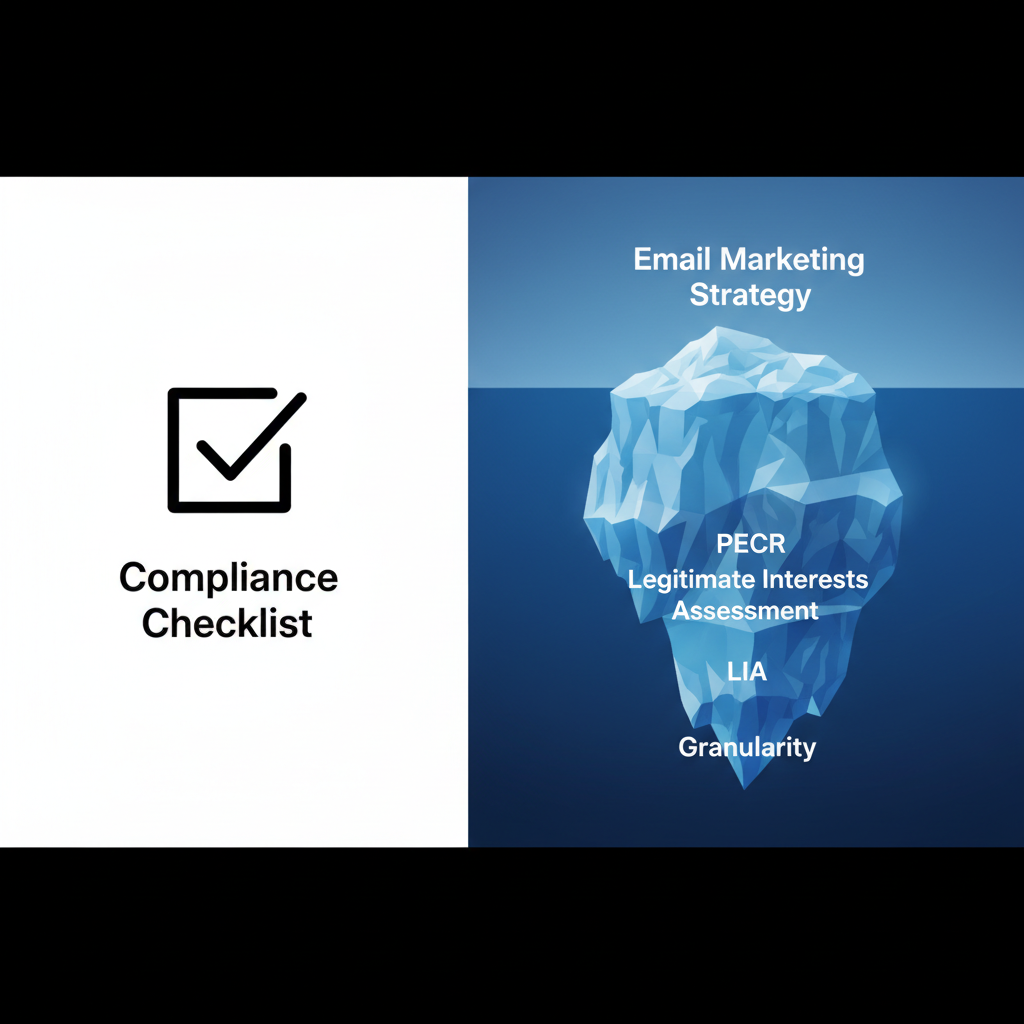
The "PECR vs. GDPR" Conflict: The #1 Misunderstanding
Here is the thing most guides won't tell you: GDPR is not the primary law governing the act of sending marketing emails in the UK and Europe. That role belongs to PECR (Privacy and Electronic Communications Regulations).
I’ve seen countless marketers spend weeks documenting their "Lawful Basis" under GDPR, only to be fined because they ignored PECR. It’s crucial to understand the hierarchy.
PECR sits on top. It dictates whether you have permission to send the electronic message.
GDPR sits underneath. It dictates how you process the personal data required to send that message.
You cannot use GDPR’s "Legitimate Interest" to bypass PECR’s requirement for consent, except in very specific "soft opt-in" scenarios. If you are sending B2C marketing emails, PECR generally requires consent. GDPR then dictates the standard that consent must meet (freely given, specific, informed, and unambiguous).
Why "Lawful Basis" Isn't "Permission to Send"
Marketers often assume that if they have a "legitimate interest" (a GDPR concept), they can email anyone. This is a dangerous myth. According to the ICO's Direct Marketing Guidance, legitimate interest applies to the processing of the data, but it does not override the statutory requirement for consent under PECR for new prospects.
Nuance #1: The "Legitimate Interest" Trap
Speaking of Legitimate Interest, this is arguably the most abused concept in email marketing. Many marketers view it as a "Get Out of Jail Free" card to email cold leads.
However, relying on Legitimate Interest requires a rigorous Legitimate Interest Assessment (LIA). You can't just feel it's legitimate; you must prove it via the "Three-Part Test."
- Purpose Test: Is there a legitimate interest behind the processing?
- Necessity Test: Is the processing necessary for that purpose?
- Balancing Test: Is the legitimate interest overridden by the individual’s interests, rights, or freedoms?
A breakdown of Recital 47 of the GDPR explicitly states that "The processing of personal data for direct marketing purposes may be regarded as carried out for a legitimate interest." Note the word "may." It is not automatic.
In my experience, where companies fail is the Balancing Test. If a user would not reasonably expect to receive an email from you based on how you got their data, your legitimate interest usually fails. If you scraped their email from LinkedIn? That fails the balancing test every time.

Nuance #2: The "Soft Opt-In" is Stricter Than You Think
There is one major exception where you can email consumers without explicit consent: the "Soft Opt-In." But be careful. I've seen brands like HelloFresh get burned here.
According to ICO enforcement action, HelloFresh was fined £140,000 largely because their reliance on the soft opt-in was flawed. They sent millions of messages, assuming past interactions equaled consent.
For a valid Soft Opt-In under PECR, you must meet all four of these conditions simultaneously:
- You obtained the contact details in the course of a sale or negotiations for a sale of a product or service.
- You are marketing your own similar products or services.
- You gave the person a clear opportunity to refuse or opt-out when you first collected the details.
- You give them a clear opt-out in every subsequent communication.
Defining "Negotiations for a Sale"
This is where it gets nuanced. "Negotiations for a sale" doesn't mean someone who just browsed your homepage. It means they actively engaged—perhaps they added an item to a cart but abandoned it, or asked for a quote. If they only signed up for a free generic whitepaper, arguing "negotiations for a sale" is a legal stretch that rarely holds up in court.
Nuance #3: Granularity & The Death of Bundling
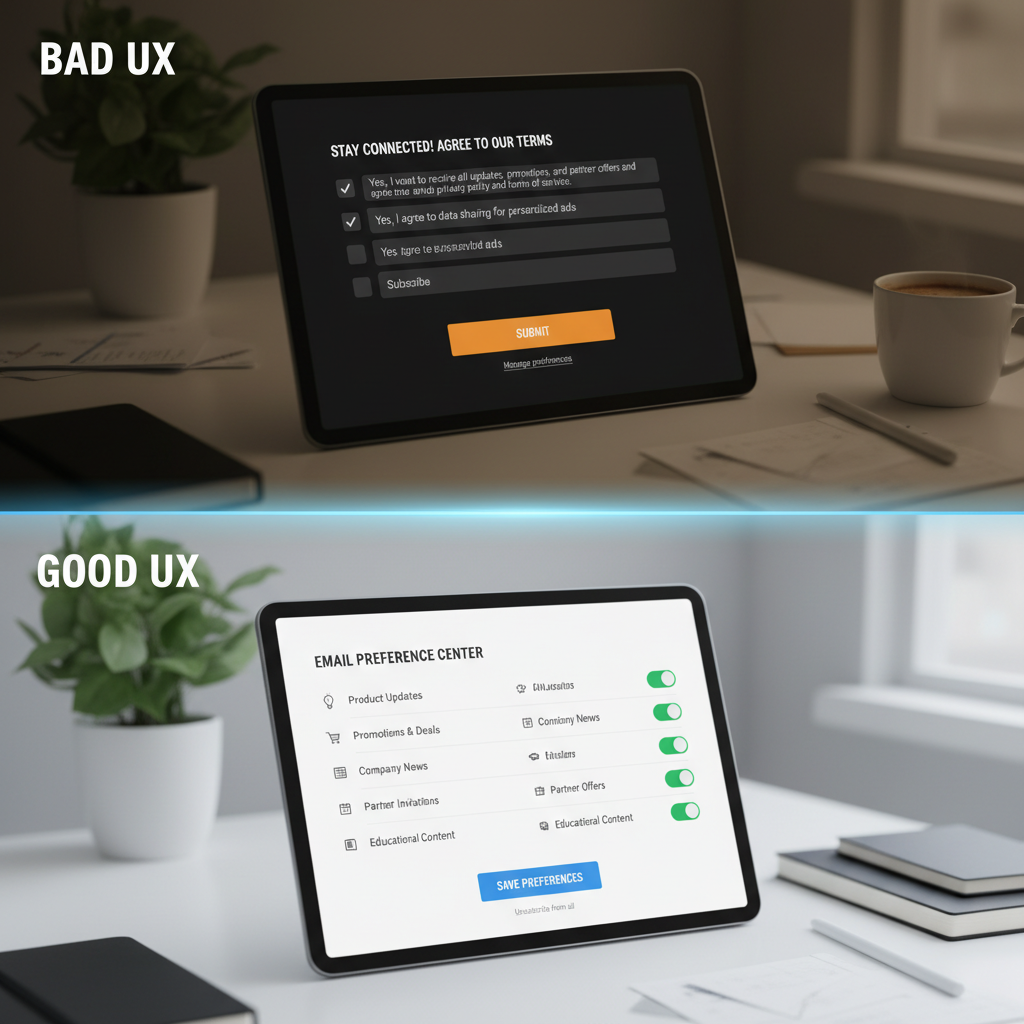
This brings us to the Italian case I mentioned in the introduction. The Italian Data Protection Authority (Garante) fined Wind Tre €16.7 million, and a significant portion of that fine revolved around bundled consent.
The company had a single checkbox that covered both marketing and data sharing with third parties. Under GDPR, consent must be "specific."
What does this mean for your forms?
- Illegal: [ ] I agree to the Terms and want to receive marketing emails. (Bundling legal terms with marketing).
- Illegal: [ ] Sign me up for the newsletter and share my details with partners. (Bundling first-party and third-party marketing).
- Compliant:
[ ] I accept the Terms of Service.
[ ] Send me the weekly newsletter.
[ ] Send me offers from trusted partners.
I know what you're thinking: "But adding more boxes kills conversion rates." While that may be true for short-term signups, data from the 2024 Cisco Data Privacy Benchmark Study suggests that nearly 80% of data leaders report that strong data privacy practices increase consumer trust. Trust drives retention, which is far more valuable than a cheap signup.
Nuance #4: The "Instigator" Liability (Viral Marketing)
We all love a good "Refer-a-Friend" campaign. It’s the engine of viral growth. But did you know you can be liable for the emails your customers send?
If you incentivize a user to forward an email or input a friend's email address to unlock a discount, you become the "instigator" of that message. According to the ICO's stance on unsolicited messages, if you encourage the sending, you are responsible for complying with PECR.
Since the friend did not give you consent, sending them an automated marketing email (even if "from" their friend) puts you in the danger zone.
The Fix: Shift the mechanism. Instead of asking for the friend's email, give the user a unique link or code they can copy and paste into their own personal email client. This removes you from the processing loop of the non-consenting party.
Nuance #5: B2B Emailing – Not a Free-for-All
There is a persistent belief that GDPR doesn't apply to B2B. This is false. While PECR offers a "Corporate Subscriber" exemption, GDPR still protects the personal data inside a corporate email address.
john.doe@company.com identifies a living individual. It is personal data.
Corporate Subscribers vs. Sole Traders
In the UK, the rules differentiate between corporate bodies (LLPs, Ltd companies) and sole traders.
- Corporate Bodies: You can email them without prior consent (under PECR), provided you offer an opt-out. However, you still need a Lawful Basis (usually Legitimate Interest) to process their personal data.
- Sole Traders: They are treated legally as individuals. You need the same level of consent as you would for a consumer (B2C).
"Corporate subscribers do not have the same PECR rights as individuals, but the personal data within their email address is still protected by GDPR." — ICO Direct Marketing Guidance
The 2024/2025 Deliverability Connection
Here is where the rubber meets the road. Compliance is no longer just about avoiding fines; it's about hitting the inbox.
As of February 2024, Google and Yahoo enforced a strict spam complaint rate threshold of 0.3%. If you exceed this, your emails get blocked. Period.
This update effectively weaponizes GDPR principles. If you are relying on shaky "Legitimate Interest" or purchasing lists, your spam complaints will inevitably rise above 0.3%. The technical giants are now enforcing what the regulators started.
Furthermore, the requirement for One-Click Unsubscribe (RFC 8058) aligns perfectly with GDPR Article 17 (Right to Erasure) and the requirement that withdrawing consent must be as easy as giving it. If you require a login to unsubscribe, you are failing both the law and Google’s requirements.
FAQ: Practical Scenarios for Email Marketers
Does double opt-in guarantee GDPR compliance?
No. While I highly recommend double opt-in for data quality, it only proves that the email address belongs to the user. If the original sign-up form was vague, bundled, or used pre-ticked boxes, the consent is invalid regardless of whether they clicked the confirmation link.
Can I email existing customers without consent?
Yes, but only under the "Soft Opt-In" rule mentioned earlier. It must be for similar products, and they must have had a chance to opt-out initially. You cannot use Soft Opt-In to start sending third-party partner offers.
How often do I need to refresh email consent?
GDPR doesn't set an expiration date. However, the ICO suggests that consent degrades over time. If a user hasn't engaged in 12-24 months, treating their consent as "fresh" is risky. Re-permissioning campaigns are a safe bet here—and they help keep your list clean for Google’s 0.3% threshold.
Is a pre-ticked box legal in 2025?
Absolutely not. Recital 32 of the GDPR is explicit: "Silence, pre-ticked boxes or inactivity should not constitute consent." If your forms still have pre-ticked boxes, you are non-compliant.
Conclusion: Moving from "Compliance" to "Brand Trust"
Navigating the nuances of GDPR and PECR is admittedly exhausting. But looking at the trajectory from 2018 to 2025, one thing is clear: the era of "grab as much data as possible" is over.
The marketers winning today aren't the ones looking for loopholes in Recital 47. They are the ones building Granular Preference Centers, respecting the Right to Object, and treating the inbox as a privilege, not a right.
When you align your strategy with these regulations, you aren't just dodging a fine. You are building a list of people who actually want to hear from you. In an age of 0.3% spam thresholds, that is the only metric that matters.