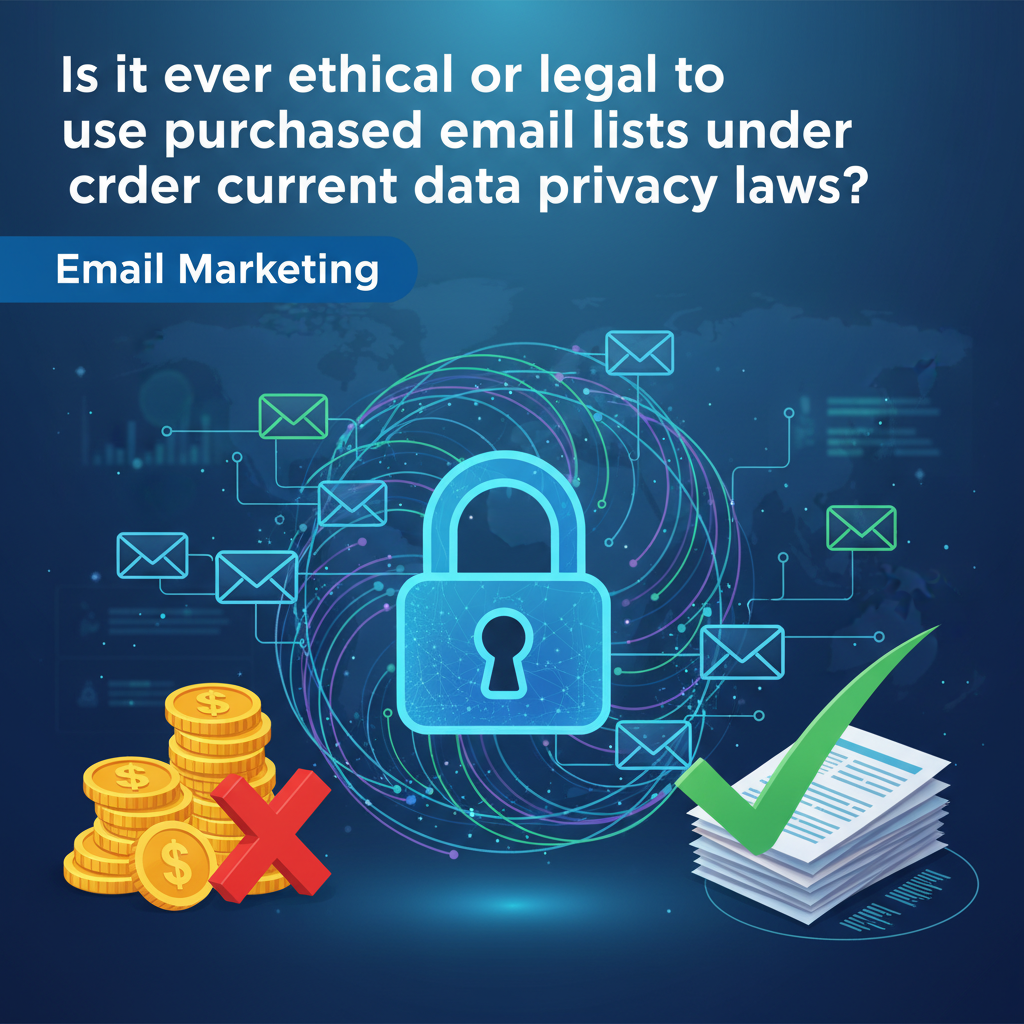
Is Buying Email Lists Legal in 2025? The Truth About Ethics, Law, and Blacklists
You can technically buy an email list without breaking US law, but you might destroy your business in the process. Here is the distinction 90% of marketers miss.
I’ve sat in boardrooms where executives, desperate for Q4 leads, slam their fists on the table demanding we "just buy the data." It’s a tempting shortcut. You see a vendor offering 50,000 "verified" B2B contacts for a few hundred dollars, and you do the math. If even 1% convert, the ROI seems massive.
But here is the reality check that usually silences the room: The law is the low bar.
While purchasing data might be legal depending on your zip code, using that data to send bulk emails is operationally suicidal. In this definitive guide, we are going to dissect the nuances between what is legal (government regulations) and what is possible (Email Service Provider rules), backed by the latest 2024-2025 data.
In This Article:
The Short Answer: Legal vs. Operational Reality
To understand why buying lists is such a minefield, you have to separate the government from the gatekeepers. The government (FTC, ICO, CRTC) sets the laws regarding fines. The gatekeepers (Google, Yahoo, Spamhaus) control whether your email actually lands in an inbox.
Laura Atkins, a founding partner at Word to the Wise, puts it perfectly:
In the United States, it is not illegal to buy a list. However, legitimate Email Service Providers (ESPs) like Mailchimp, HubSpot, and Klaviyo strictly prohibit using purchased lists in their Terms of Service. Why? Because purchased lists destroy their server reputation.

The Legal Landscape: Where You Live Matters
Internet privacy laws are not global; they are aggressively local. Before you swipe your credit card for that list of 10,000 CEOs, you need to know which jurisdiction applies to your recipient.
1. United States: The CAN-SPAM Act (The "Opt-Out" Model)
The United States operates under an "Opt-Out" model. Surprisingly to many, unsolicited commercial email is legal in the US.
According to the FTC's CAN-SPAM Act Compliance Guide, you do not need prior consent to email someone. However, you must comply with strict rules once you do send:
- You must provide a clear, easy way to opt-out (unsubscribe).
- You must honor opt-out requests within 10 business days.
- You must include a valid physical postal address.
- You cannot use deceptive subject lines or headers.
2. European Union: GDPR (The "Opt-In" Model)
If your purchased list contains data from EU citizens, the rules flip entirely. Under the General Data Protection Regulation (GDPR), you must have "specific, informed, and unambiguous" consent before sending marketing emails.
The UK Information Commissioner's Office (ICO) clarifies that "indirect consent" (where a user agrees to share data with 'third party partners') is rarely sufficient for email marketing. If you buy a list, those people did not explicitly consent to hear from your specific company. Therefore, emailing them is a violation of GDPR.
3. Canada: CASL (The Strictest Standard)
Canada’s Anti-Spam Legislation (CASL) is widely considered the toughest in the world. According to the CRTC CASL Requirements, you generally need "express consent" to send a Commercial Electronic Message (CEM).
Unlike the US, where you can send until told to stop, in Canada, you cannot start until told to go. The fines here are astronomical, reaching up to $10 million for corporations.
The "Hidden" Sheriff: Private Spam Filters & Blocklists
Let’s assume you are in the US and compliant with CAN-SPAM. You are legally in the clear. Now you face the real problem: The Spamhaus Project.
Spamhaus is an international non-profit that tracks spam producers. They don't care about the law; they care about network abuse. According to The Spamhaus Project, their blocklists protect over 3 billion mailboxes globally. If your IP address or domain lands on the Spamhaus "Zen" list, your email will be blocked by virtually every major corporate server, ISP, and security filter in the world.
How do they catch you? Spam Traps.
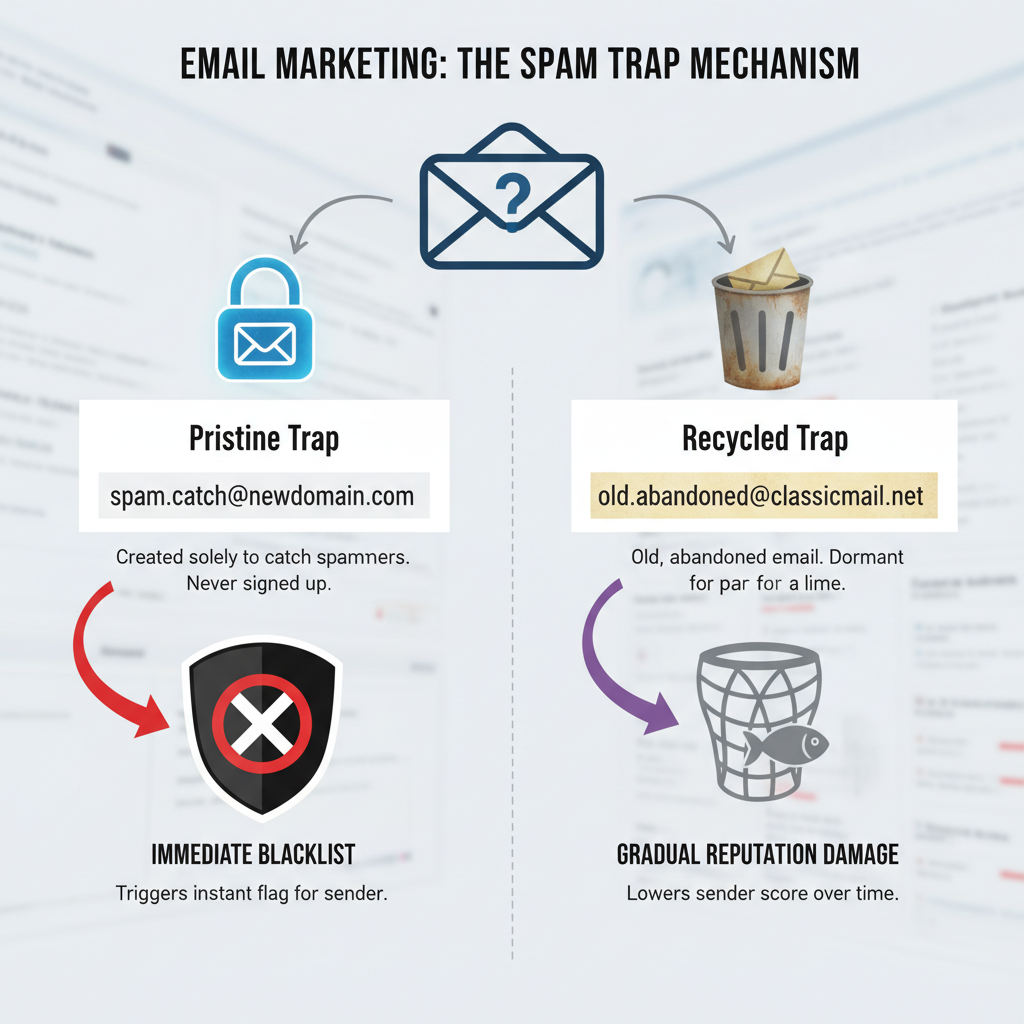
The Mechanism of Failure
Purchased lists are notoriously dirty. According to a 2024 report by Keepnet Labs, 56.5% of all email traffic was identified as spam. Vendors build these lists by scraping websites. Inevitably, they scrape "Pristine Spam Traps"—email addresses hidden in website code specifically to catch scrapers.
If you hit a pristine trap, it proves you didn't get permission. You are immediately blacklisted. This isn't a legal penalty; it's a death sentence for your domain reputation.
The Ethical & Performance Argument (The "Why You Shouldn't")
Beyond the legal risks and the blocklists, there is the simple argument of efficacy. Does buying lists actually work? The data suggests a resounding "No."
1. The ROI Gap
We often hear that email marketing has the highest ROI of any channel. That is true, but there is a caveat. According to Litmus's State of Email 2024, email marketing returns an average of $36 for every $1 spent. However, this ROI is calculated based on permission-based lists.
Conversely, open rates for unsolicited/purchased lists frequently plummet below 2%, compared to the 20-25% average for organic lists seen in MailerLite's 2024 Benchmarks.
2. Case Study: The "Netpeak" Anti-Pattern
I recall reviewing a case from the Netpeak Agency logs where a client attempted to bypass best practices by uploading a purchased list disguised as organic. The results were immediate and catastrophic:
- Unsubscribe Rate: 20% (Industry norm is <0.5%)
- Spam Complaint Rate: 7% (Anything above 0.1% puts you in the danger zone)
The client's domain reputation tanked from "Good" to "Bad" on Google Postmaster Tools, meaning their legitimate emails to actual clients started going to spam. It took three months of "warm-up" repair to fix the damage caused by one blast.
3. Case Study: The Dan Bannister Effect
Reputation damage isn't just algorithmic; it's personal. Photographer Dan Bannister once bought a "verified" list for $10,000 to promote his portfolio. He ended up emailing Chris Anderson, the editor of Wired Magazine.
Anderson didn't just delete the email; he publicly shamed Bannister on the Wired blog, labeling him a spammer. The reputational fallout was immense. In the B2B world, people talk. If you are the company spamming executives, you aren't building brand awareness; you are building brand toxicity.
If You Must: The Only "Safe" Way to Use Cold Data
I know that sometimes, despite the risks, businesses need to do cold outreach. If you are going to use purchased data, you must shift your mindset from "Bulk Marketing" to "Lead Generation."
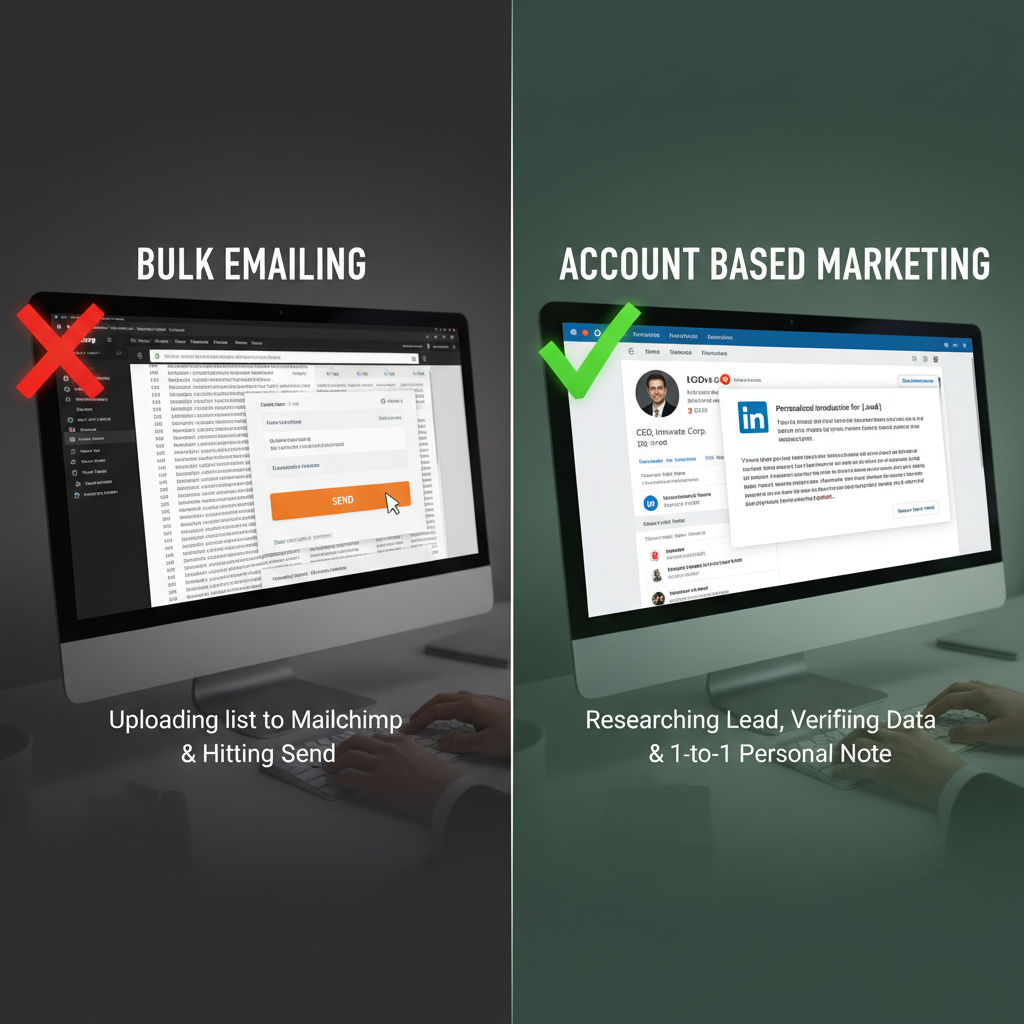
Here is the only ethically grey-but-acceptable workflow:
- Use the Data for Research, Not Sending: Buy the list to identify companies and titles that fit your Ideal Customer Profile (ICP).
- Verify Individually: Don't trust the vendor. Go to LinkedIn. Does that person still work there?
- One-to-One Outreach: Do not upload these contacts to an ESP like Mailchimp. Send a personal, individual email from your business account (or a sales engagement platform like Outreach.io, provided you adhere to sending limits).
- Zero-Party Data Alternatives: Instead of buying lists, invest that budget into "Lead Magnets." Create a high-value whitepaper or webinar. According to HubSpot's State of Marketing Report, inbound leads cost 61% less than outbound leads on average.
FAQ: Common Questions on Email Compliance
Is it illegal to buy email lists for marketing in the USA?
No, it is not illegal to buy the list itself, nor is it illegal to send unsolicited email under the CAN-SPAM Act, provided you include an opt-out mechanism and a physical address. However, it violates the Terms of Service of almost every reputable Email Service Provider.
Can you go to jail for buying email lists?
It is highly unlikely you would go to jail simply for buying a list or sending spam, as these are civil violations, not criminal ones. However, under CAN-SPAM, you can face civil penalties of up to $51,744 per violation. Criminal charges generally only apply to hacking, identity theft, or fraud associated with spam.
Does GDPR ban buying email lists?
Effectively, yes. While buying the data might not be illegal per se, processing that data (i.e., sending an email) without prior consent is a violation of GDPR Article 6. Since purchased lists rarely have valid "third-party consent," using them puts you at risk of fines up to €20 million or 4% of global turnover.
How do I know if a purchased list has spam traps?
You don't. That is the trap. Vendors will claim their lists are "clean" or "verified," but pristine spam traps are secret addresses that never bounce and never sign up for anything. The only way to know you hit one is when Spamhaus blocks your domain.
What is the best alternative to buying lists?
The most sustainable strategy is building organic lists through Lead Magnets. Offer value (checklists, industry reports, discount codes) in exchange for an email address. This ensures high intent and protects your sender reputation.
Conclusion: Building Assets vs. Buying Liabilities
In my experience consulting for companies ranging from startups to Fortune 500s, the decision to buy an email list almost always stems from panic. It’s a desire to bypass the hard work of audience building.
But in 2025, an email list is only an asset if it has permission attached to it. A purchased list is a liability. It carries the weight of potential legal fines, the certainty of lower engagement, and the high risk of domain blacklisting.
If you buy a list, you are renting access to people who haven't asked to hear from you. If you build a list, you are owning an audience that actually wants to buy. The law might say you can do the former, but business sense dictates you must do the latter.